

Tracking current vulnerabilities isn't just for large enterprises with dedicated security teams. For small and mid-sized businesses, staying aware of the latest threats is a critical part of maintaining a strong security posture.
Highlights from the CISA Known Exploited Vulnerabilities Catalog
The CISA Known Exploited Vulnerabilities (KEV) Catalog is the authoritative source for vulnerabilities that are being actively exploited in the wild. In May 2026, CISA added over a dozen new vulnerabilities to the catalog — spanning Microsoft Windows, Adobe Acrobat, web hosting control panels, and even widely used desktop utilities.
Here are some of the most notable additions from May 2026:
May 20 — Seven vulnerabilities added, including: - CVE-2026-41091 — Microsoft Defender Elevation of Privilege vulnerability, allowing attackers to gain SYSTEM-level access on affected Windows systems - Microsoft Windows RPC buffer overflow — previously patched but actively re-exploited in targeted attacks - Microsoft Internet Explorer use-after-free — proof that legacy software continues to be a prime attack vector - Adobe Acrobat and Reader flaws — exploited through malicious PDF documents delivered via phishing campaigns
May 21 — Two additional vulnerabilities: - CVE-2026-34926 — Trend Micro Apex One directory traversal vulnerability, enabling attackers to read arbitrary files on affected endpoints - Langflow origin validation error — an open-source low-code AI tool targeted for data exfiltration
May 26 — A critical web hosting flaw: - CVE-2026-48172 — LiteSpeed cPanel Plugin privilege escalation (CVSS 10.0, critical). This maximum-severity flaw allows attackers to gain root-level access on web servers running the plugin, affecting versions 2.3 through 2.4.4
May 27 — Supply chain compromise: - CVE-2026-8398 — DAEMON Tools Lite supply chain attack. Attackers compromised the official build infrastructure of AVB Disc Soft and trojanized three signed installer binaries (DTHelper.exe, DiscSoftBusServiceLite.exe, DTShellHlp.exe) distributed from the legitimate daemon-tools.cc website between April 8 and May 5, 2026. Because the installers were signed with the vendor's legitimate code-signing certificate, they appeared fully authentic, making this particularly dangerous for organizations that downloaded or distributed the compromised software
Key patterns observed this month include:
- Remote code execution flaws in widely deployed edge devices
- Privilege escalation vulnerabilities in operating system components
- Cross-site scripting and injection flaws in web applications
Common Patterns We're Seeing
Across the vulnerabilities reported this month, a few patterns stand out:
- Unpatched systems remain the #1 risk — many of the exploited vulnerabilities have patches available, but organizations haven't applied them
- Misconfigured cloud services continue to be a leading attack vector
- Outdated software versions are disproportionately represented in breach reports
Practical Steps SMBs Can Take This Month
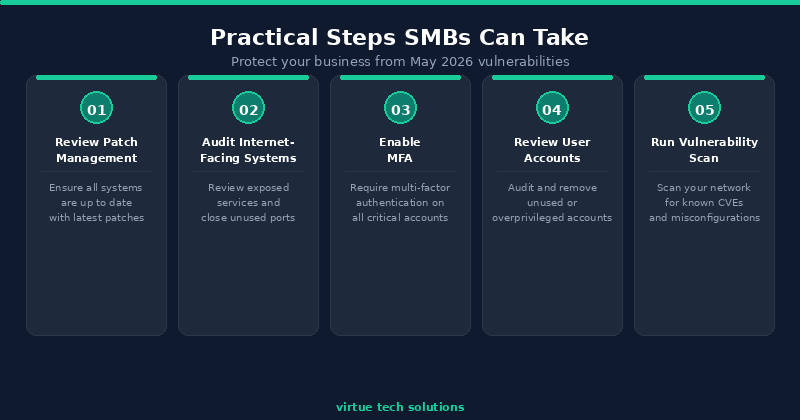
You don't need a massive security budget to stay ahead. Here are actionable steps:
- Review your patch management cadence — are critical patches applied within 7 days? Our [managed IT services](/services/it-managed-services) include automated patch management and continuous vulnerability monitoring.
- Audit internet-facing systems — do you know every device exposed to the public internet?
- Enable multi-factor authentication everywhere it's supported
- Review user accounts — remove inactive accounts and verify permissions
- Run a vulnerability scan — even a basic scan can reveal obvious gaps
Conclusion
Ongoing vulnerability management is a core security practice, not a one-time project. By staying informed about current threats and maintaining a disciplined patch and monitoring routine, SMBs can significantly reduce their risk without incurring enterprise-level costs.
A comprehensive cybersecurity program that includes regular vulnerability assessments, managed detection and response, and compliance-aligned controls can keep your business protected without requiring a dedicated internal security team.
Need help assessing your current vulnerability management program? Contact Virtue Technology Solutions for a no-pressure consultation.