

Cybersecurity can feel overwhelming, especially for small and mid-sized businesses that do not have a dedicated security team. Between ransomware attacks, phishing campaigns, compliance requirements, and vendor risk assessments, it is easy to feel like you are always a step behind.
The good news is that effective cybersecurity for an SMB does not require a massive budget or a room full of security engineers. It comes down to covering a handful of essential layers — and making sure each one is actually working. When these layers are in place, you block the vast majority of attacks that target businesses your size.
Here are the basic layers every SMB needs, explained without the jargon.
---
Layer 1: Multi-Factor Authentication (MFA)
What it is: MFA requires anyone logging into your systems to present two or more proofs of identity — typically a password plus something they have (like a phone app notification) or something they are (like a fingerprint).
Why it matters: Passwords alone are not enough. They get stolen through phishing, data breaches, and weak password reuse at an alarming rate. MFA blocks over 99.9 percent of account compromise attacks, according to Microsoft. It is the single most cost-effective security control you can implement.
Where to start: Turn on MFA for every account that supports it — email, cloud apps, VPN, remote desktop, and administrative portals. Start with Microsoft 365 and Google Workspace, then move to every other platform you use. Require MFA for all users, not just administrators.
Common mistake: Enabling MFA but allowing users to bypass it with app passwords or text message codes. Use authenticator apps or hardware security keys for the strongest protection.
---
Layer 2: Patch and Vulnerability Management
What it is: Patch management is the process of keeping your software, operating systems, and firmware updated with the latest security fixes. Vulnerability management adds a layer of proactive scanning to identify missing patches and misconfigurations before attackers exploit them.
Why it matters: The majority of successful ransomware attacks exploit known vulnerabilities that already have patches available. Attackers do not need zero-day exploits when most organizations take weeks or months to apply critical updates.
What good looks like:
- Critical security patches are applied within 7 days of release
- Important patches are applied within 30 days
- Firmware and driver updates are addressed in quarterly maintenance windows
- Automated patch deployment is configured through an RMM or MDM tool
- Regular vulnerability scanning identifies gaps that patching alone may miss
For SMBs: Manual patching does not scale. If you have more than 10 devices, you need an automated tool. Our managed IT services include patch management as a core part of our service delivery, and we treat it as non-negotiable.
---
Layer 3: 24x7 Managed Detection and Response (MDR)
What it is: MDR combines advanced endpoint detection technology with a human security team that monitors alerts 24 hours a day, 7 days a week. When something suspicious happens on a device in your network, the MDR team investigates it, determines whether it is a real threat, and takes action to stop it.
Why it matters: Most breaches are detected by a third party — not by the victim's own team. Attackers dwell inside networks for an average of weeks or months before being discovered. MDR cuts that window from months to minutes. For an SMB that does not have a security operations team, MDR is the closest thing to having a 24x7 security team on staff.
What MDR typically covers:
- Endpoint detection and response (EDR) on every workstation and server
- 24x7 alert monitoring by a security operations center
- Threat hunting to find attackers who may have evaded initial detection
- Automated containment of compromised devices to prevent lateral movement
- Root cause analysis and remediation guidance after an incident
For SMBs: Modern MDR solutions are affordable and cloud-delivered, requiring no on-premise hardware. They are designed to be managed by an external team — you do not need to hire security analysts to benefit from them.
---
The Four Essential Security Layers
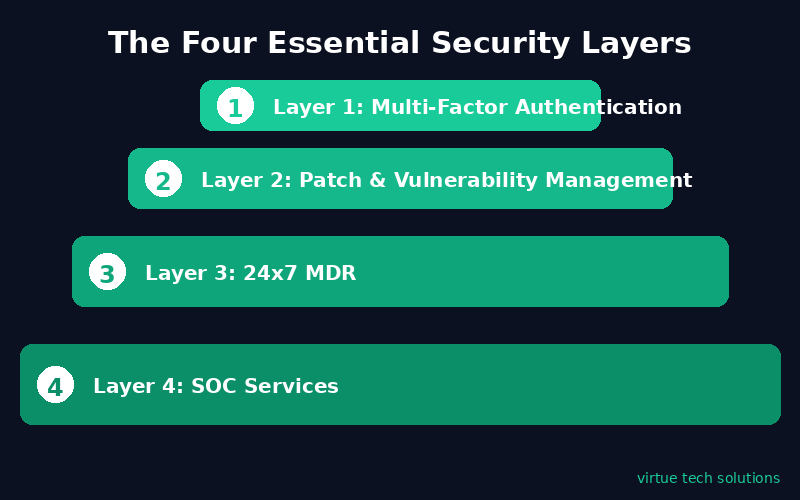
For SMBs: Full SOC services used to require building a dedicated team and a physical operations center. Today, SOC-as-a-Service models give SMBs access to enterprise-grade monitoring at a fraction of the cost. Many managed IT providers, including Virtue Technology Solutions, offer SOC services as part of a comprehensive managed security program.
---
Bringing It All Together: The Layered Approach
Each layer is important on its own, but their real power comes from working together:
- MFA — Stops stolen passwords, credential stuffing, and basic phishing. Without it, one compromised password gives attackers full access.
- Patch management — Stops known exploits and ransomware that targets unpatched systems. Without it, attackers walk through open doors using publicly known vulnerabilities.
- MDR — Stops advanced malware, ransomware execution, and lateral movement. Without it, a single compromised device becomes a full network breach over weeks.
- SOC services — Stops email threats, identity attacks, network intrusions, and compliance gaps. Without them, threats outside endpoint visibility go completely undetected.
When all four layers are active, you are protected against the vast majority of attacks that target SMBs. When even one layer is missing, you have a gap that attackers will find.
---
Easy-to-Understand Summary
Cybersecurity for SMBs comes down to four basic layers:
- MFA — Require a second form of verification for every login. This alone blocks 99.9 percent of account attacks.
- Patch and vulnerability management — Keep your systems updated and scan for what you missed. Most ransomware exploits patches that were available months ago.
- 24x7 MDR — Deploy endpoint detection on every device with a human team watching the alerts around the clock.
- SOC services — Extend monitoring beyond endpoints to email, cloud, and network traffic so nothing slips through.
You do not need to implement all four overnight. Start with MFA — it is free or very low cost and takes a few hours to set up. Then work through the layers one at a time. Every layer you add dramatically reduces your risk.
At Virtue Technology Solutions, we build cybersecurity programs for SMBs that cover all of these layers — designed to fit your budget, your team size, and your risk profile. We do the monitoring, the patching, and the response so you do not have to.
Ready to assess where your business stands against these four layers? Contact Virtue Technology Solutions for a no-pressure consultation.